What does living actually mean?
Action n°15 – ABITAZIONE
To what extent can the social changes of the 20th century be linked to living conditions? What changes in the contemporary living of a space and what does not change? “Abitazione” From Latin. habitare, frequentative from habère to havè – ‘to hold’. Living therefore means to hold a certain place and to adopt habits; this concerns local (current) habits or the production of new habits. The “art of living” is built around the living like a dress. Through this unconventional living action of a non-residential place, the boundaries of current living are expanded and current forms of living are explored by the artist. “I will move to the Art von Frei gallery for 168 hours. I will survive solely through interaction and communication. I will speak to people who visit the gallery and happen to walk in front of the shop window, and establish a relationship with the web-omnipresent society. I will expand and explore my privacy.” Ben Jones documents and monitors the action with his camera. Through the deprivation of conventional living conditions, an artificial living situation is created in which the artist presents the experience himself as a production. The artist as a self-researcher in changing situations, which can then lead to unusual forms of living.
Action n°15 - ABITAZIONE
Art Von Frei Gallery, Berlin (Germany). Durational performance, 168 continuous hours
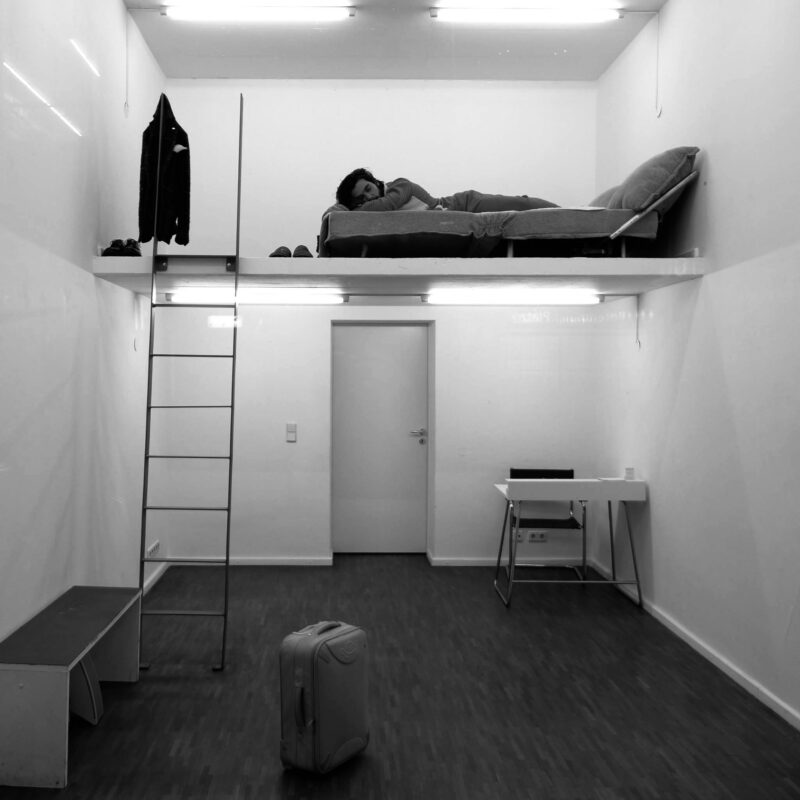
Berlin – At Art Von Frei Gallery, at the invitation of curator Eva Moll, Gio Montez realized Action n°15 – ABITAZIONE, a durational performance lasting 168 consecutive hours, transforming the exhibition space into a site of real life, artistic production, and social interaction.For this action, the artist chose to exhibit himself and his way of inhabiting the contemporary condition, staging a radical reflection on the concept of DWELLING as a physical, social, and relational space. Montez arrived at the gallery carrying only hand luggage: a few changes of clothes, a Polaroid camera with spare cartridges, several notebooks, pastels, and charcoal. No pre-existing artworks. The artist’s entrance into the gallery marked the official beginning of the performance.
Inside the space, Montez constructed a minimal DWELLING: a bed on the mezzanine, clearly visible from the large glass wall overlooking Brunnenstrasse, an outdoor shower head near the entrance, and a bucket for washing. From that moment on, he lived continuously in the gallery—sleeping, eating, drawing, browsing the internet, and freely improvising with whatever objects entered the space—never restraining his imagination. A central element of the action was the strategic use of social media as a tool for performance marketing and direct engagement with the surrounding neighborhood. Through provocative and ironic messages—“I’m hungry, help an artist do the grocery shopping,” “I need to take a shit but I have no toilet paper,” “Brush my back,” “I’ve run out of salt, can you lend me toothpaste?”—Montez activated a digital audience, prompting it to convert virtual contact into physical visits to the gallery. Over the course of the week, the gallery became a lived-through space for the neighborhood: visitors, passersby, and local residents brought objects, food, and materials, establishing direct relationships with the artist, who gradually became a familiar and recognizable presence. Using everything that was delivered, Gio Montez improvised artistic compositions in real time, transforming everyday objects into artworks. The motto of the action originated from a sticker casually placed on the gallery window by a passerby: “Something Kunst.” Montez reworked it into “Give me anything and I’ll make something Kunst,” incorporating it into one of the works produced during the period of confinement. The phrase became a programmatic statement of a creative, relational, and open approach, affirming that in contemporary society the human being cannot survive without others. The concept of the individual is surpassed by that of an expanded corporeality, extending beyond the physical body into digital and relational space.
DWELLING thus takes shape as an experiment in “limit-less contemporary living,” a practice of life without boundaries, in which art coincides with everyday existence and artistic production emerges from encounter, exchange, and collaboration. At the end of the 168 hours, the opening event spontaneously transformed into a neighborhood celebration, a collective affirmation of contemporary life. At the finissage, Gio Montez presented 56 completed works, all signed unique pieces, produced exclusively from the materials and objects brought into the gallery by the public during the week-long action. With Action n°15 – ABITAZIONE, Gio Montez redefines the concepts of home, artist, and community, transforming the gallery into a living, inhabited, shared organism. A radical gesture that questions the boundaries between art, life, and relationships, asserting art as a practice of existence.
dwelling /ha·bi·ta·tion/ n. (f.)[from Late Latin habitatio, -onis]
— A set of spaces in which one lives on a permanent basis. The word DWELLING primarily denotes the act of dwelling or of being inhabited. Alongside this somewhat abstract meaning, there is a concrete and much more common one: a dwelling is a place that a human being builds, or chooses or adapts from those available in the natural environment, as a shelter—permanent or temporary—for oneself and one’s family. A dwelling takes different forms depending on climatic conditions, the means by which it is constructed, and the social and cultural organization of a group or society. It can therefore range from a simple shelter made of branches, easily built and transportable and thus suitable for the lifestyle of nomadic populations, to a highly complex structure such as a skyscraper, which can house thousands of people and rise vertically for hundreds of meters. In everyday usage, the word dwelling refers to a house, an apartment, a building, or a part thereof.