Action n°29 – TEATRALIZZAZIONE by Gio Montez
Castello Chigi Albani, Soriano Nel Cimino (VT) – With the gracious authorisation of Mayor Fabio Menicacci and Artistic Director Paolo Berti, Gio Montez realised Action n°29 – TEATRALIZZAZIONE at the Castello Chigi Albani in Soriano nel Cimino, a collective performance unfolding from dawn to dusk, immersed in one of the most evocative historical and architectural complexes in central Italy. The Castello Chigi Albani, once known as the Spelonca del Madruzzo, is a site layered with history and myth. Originally attributed to Cardinal Cristoforo Madruzzo—who is credited with commissioning the Fountain of Papacqua and the nearby Moses complex, traditionally associated with the circle of Michelangelo and Leon Battista Alberti—the palace later became the residence of the Chigi-Albani family and subsequently of the Orsini, who added the second floor. After years of neglect and abandonment, during which Nature slowly reclaimed the structure—causing floors and towers to collapse and covering vertical walls with climbing plants—the site appeared as a wounded yet enchanted organism. This state of ruin, charged with a disturbing and magnetic force, became the primary call to action for the artist.
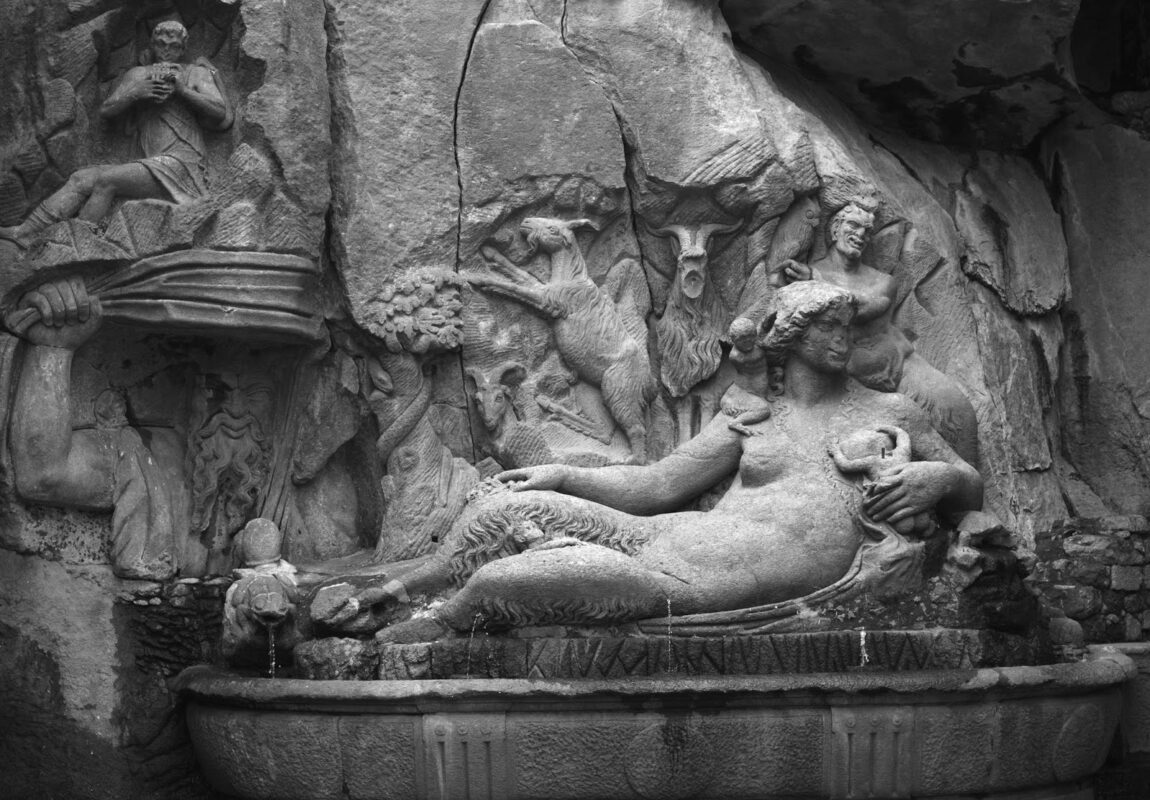
For Theatricalization, Gio Montez drew direct inspiration from the Fountain of Papacqua, an extraordinary Mannerist sculptural complex carved into gray and pink peperino stone, from which a spring of exceptionally pure water emerges. The sculptural figures, all rooted in a pre-Christian, pagan imagination, culminate symbolically in the figure of Moses striking the rock to bring forth water—where the natural emergence of the spring takes the form of a miracle. Montez chose to theatricalize these allegorical and symbolic presences—Pan, Nature and its creatures: the owl, frog, goat, turtle, snail and snake—translating them into living bodies, into incarnated archetypes. The artist directed a 24-hour collective performance throughout the palace complex, placing performers in direct contact with the disruptive and regenerative force of Nature itself. By opening both the front entrance and the rear gate overlooking the hanging garden, Montez transformed the castle into an explorable performative circuit—a diffuse Bacchic theatre, with multiple stages scattered between interior and exterior spaces. The action unfolded through five performative stations, active for the entire day, allowing visitors to move freely and experience the castle as a journey suspended between past and present, between architectural ruin and ritual scene. For each performer, Gio Montez composed a specific action score consistent with the symbolic nature of the animal embodied. The performers were invited to confront their animal alter ego, to become the symbol, to act as a guardian animal for one day, pushing the physical, psychological, and epidermal limits of incarnation. The aim was to generate a thaumaturgical experience, focusing the performer on a radical identification with the symbolic animal.
Violet’Or – The Owl
In the grotto housing the ancient watering trough, the performer challenged her body by standing barefoot in icy water while playing a Tibetan singing bowl and drinking wine. Sound, alcohol, and cold induced a hypnotic trance state, bordering on hypothermia as a ritual threshold. Approaching spectators encountered a basin enveloped in darkness, where a barefoot figure emitted resonant sounds in deep meditation.
Giuseppe Grasso – The Turtle
Naked and bound to an internal column of the fortress, the performer was tethered by a rope around his ankles, allowing limited movement forward and backward. He could enter and exit the palace threshold like a turtle’s head emerging from its shell, approaching the spring of the fountain without ever reaching it. Exposed all day to cold wind and thirst, his only refuge remained the “shell” of the fortress itself.
Lucrezia Schmidt – The Frog
Entering the scene nude, her body entirely coated in latex like a second skin, the performer positioned herself on the rock beneath the waterfall near the large external basin. She repeatedly soaked herself until her body temperature dropped enough to allow immersion in the icy water, then enacted a symbolic shedding of skin, signifying regeneration and rebirth. Visible even from the street outside the palace, the performance caused public scandal and agitation, leading local residents to file a formal complaint with the authorities.
Giulia De Sanctis – The Goat
Naked and dancing on gravel to the sound of drum and Pan’s flute, the performer embodied the lost goat pursued by the satyr. Forced into relentless movement, she ascended the steep garden path until reaching the hearth, where she finally found relief and balm for her bleeding wounds.
Riccardo Grandi – PANOCCHIO, the Shaman-Goat
Guardian of the hearth, he kept the fire burning continuously for 24 hours, even during rain and the cold of the night, offering a symbolic and physical center of gathering for the exhausted performers.
Kaey collaborated as assistant director and created the installation of the “flock” in the hanging garden—an assemblage of goat and cow hides suspended with crutches. Antonio Cicerone served as sound designer, while Thomas Fasciana curated the video documentation. Among the attendees were Prince Danilo Moncada Zarbo di Monforte and Claudio Caruselli, the American gallerist Greg Smith of the Contemporary art & editions, curator Scilla Maris, Artistic Director Paolo Berti, art critic Giorgio Di Genova, and then-Mayor Fabio Menicacci.
Gio Montez directed the entire collective of the Action n°29 – TEATRALIZZAZIONE performance and produced a series of photographic portraits of the performers, capturing their temporary incarnation of the allegorical figures and symbols of the Fountain of Nature. Theatricalization, understood as archetype in action, emerges here as the passage from sculpted symbol to living body: when myth is interpreted performatively, and the site itself becomes stage, ritual, and active memory.
the·a·tri·cal·i·za·tion n. (f.)
The act of theatricalizing and its result. A set of theatrical initiatives promoted by local administrations with public funding. Theatricalization, or Archetype in Action: When a symbol is interpreted performatively, as in the case of the clown who embodies the archetype of the fool.