
Action n°14 – Frustrazione
October 8, 2017 Mondrian Suite,
Rome – On the occasion of the exhibition Dreamlike Excursions, curated by Klaus Mondrian, the spaces of Mondrian Suite were transformed into a hybrid stage where performing arts and visual arts converged, fusing space and time into a single collective experience inspired by the dimension of the dream.
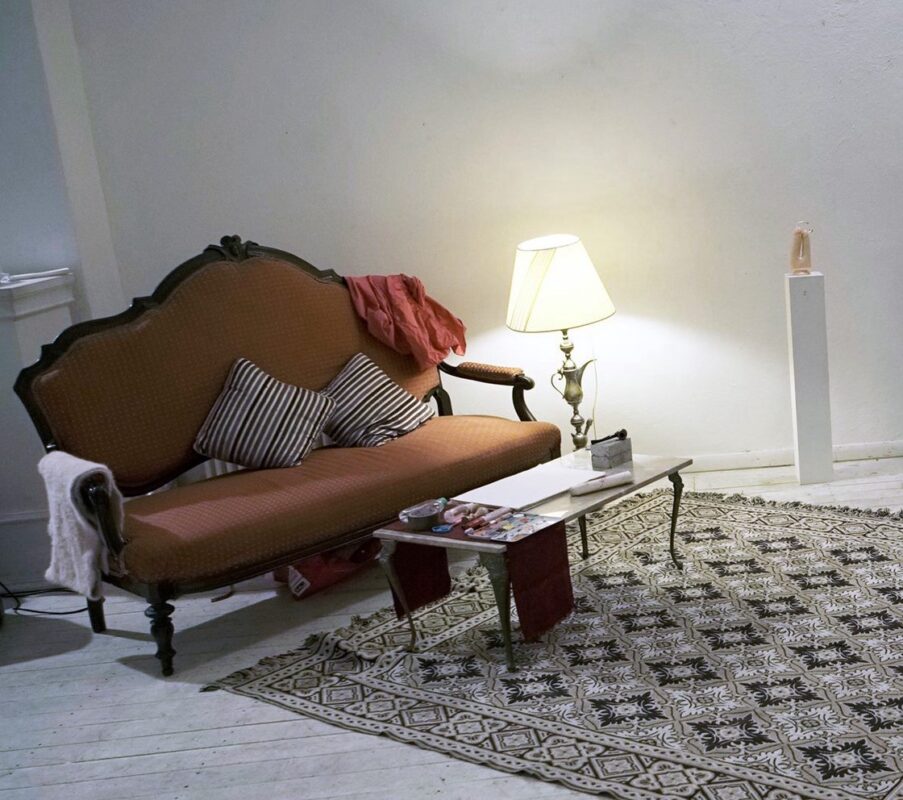
Within this context, Gio Montez presented Action n°14 – Frustrazione, a performative intervention that staged the perversion of desire and the short circuit between expectation and fulfilment. Mondrian Suite, historically recognised as a key venue for Rome’s queer scene, became the ideal device for an action that draws upon that imaginary in order to subvert it from within. Montez sets up a domestic living room saturated with fetish objects of desire—a rubber dildo, a silicone breast, a lipstick—alongside his personal effects: a pencil, a notebook, a bottle of wine, a pipe. The artist sits on the sofa, pours himself wine, and initiates the performance in an atmosphere that appears intimate and seductive.
Addressing the audience, Montez asks for volunteers. Only men respond. The artist involves them one by one, but in a deliberately unexpected manner that does not correspond to their implicit erotic fantasies. He asks them to undress, turning them into objects of his own dream. The participants, caught between staged modesty and a desire for protagonism, comply. Montez oils their bodies, initially suggesting an intensification of pleasure—a promise that will soon be betrayed. Once full compliance is achieved, the artist begins to immobilise the bodies with packing tape. The volunteers allow themselves to be guided, convinced they can endure whatever the artist intends to do. When the bindings are complete, Montez returns to the sofa and invites the audience to share with him the contemplation of these body-objects, now reduced to living living-room sculptures. It is at this point that the action reveals its conceptual core. Helpless and inert, the participants gradually realize that the artist has no intention of providing them with pleasure. Some attempt to free themselves; others break the silence with verbal provocations, voicing the gap between what they had imagined and what is unfolding.
After a contemplative pause, Montez resumes work on the bodies, further intensifying the immobilization and silencing those who had begun to speak, disrupting the elevated, suspended state shared by artist and audience. The performance continues until the volunteers—now fully aware of having been stripped of their expectations—beg to be released. Humiliated and disillusioned, they ask to be untied, to dress again, and to remove themselves from the mocking gaze of the audience. Montez states that he has betrayed no one: they betrayed themselves, because it was their own imaginary that promised an outcome which the artist deliberately chose to deny.
Action n°14 – Frustrazione stages the fracture between desire and reality, transforming the erotic dream into an experience of suspension and lack. A raw and lucid action that employs queer imagery not to confirm it, but to expose its projections, making frustration not a failure, but an aesthetic and cognitive condition.
frustration n. [from Latin frustratio, -onis “disappointment,” from frustrare “to thwart, to frustrate”]
The feeling experienced by someone who perceives their actions as having been, or as being, futile; to feel a sense of frustration. In psychology, a condition of psychic tension caused by the failure or obstruction of the satisfaction of a need; it may have external causes (e.g., an overly authoritarian upbringing) or internal causes (e.g., the presence of two needs of equal intensity but opposite direction or otherwise incompatible). In a more specific sense, in psychoanalysis, the effect resulting from the non-satisfaction of a drive.