Action No. 21 – RESURRECTION Gio Montez San Rocco Museum and the Historic Center of Trapani – Palm Sunday 2023
Trapani – During Holy Week 2023, as part of the exhibition project Untitled. Ad renovationem urbis, curated by Mons. Liborio Palmeri at the San Rocco Museum in Trapani, Gio Montez realized Action No. 21 – RESURRECTION, a large-scale collective action that intertwined contemporary art, religious ritual, and public participation, placing itself at the heart of the historic Procession of the Mysteries of Trapani.
The action originated from the artist’s desire to dedicate a new allegorical float to the Guild of Artists, entrusting contemporary artists with the task of preserving and transmitting the most ineffable mystery of the Christian tradition: the Resurrection of Christ. As Mons. Liborio Palmeri, artistic director of the San Rocco Museum and promoter of the initiative, stated, “The Resurrection is the most mysterious and ineffable of mysteries, the one that can never be fully grasped.”
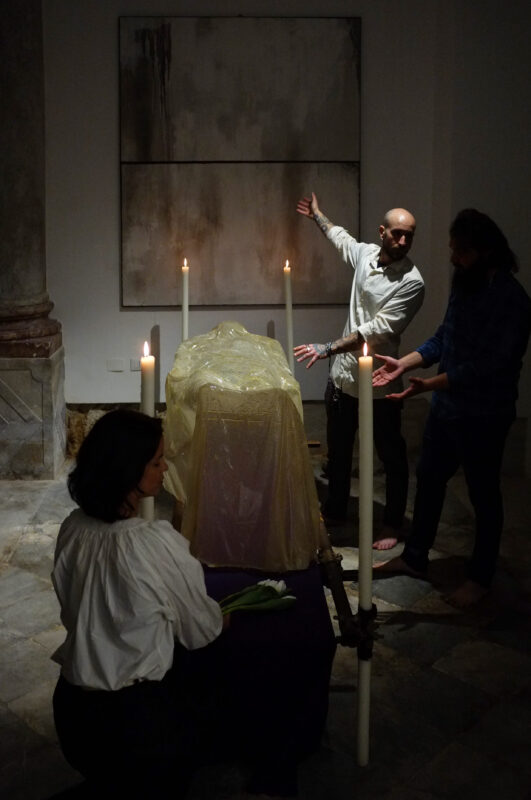
The performance began inside the San Rocco Museum, where Montez had installed the Holy Sepulchre, an installation around which the newly formed Guild of Artists gathered. On the museum’s first floor, a Tableau Vivant depicted Mary Magdalene, Saint John, and Saint Peter at the moment they discover the empty tomb and witness, in astonishment, the mystery of the Resurrection. Not the presence of Christ’s body, but its absence became the focal point of the representation.
From this initial image, the collective action unfolded. Artists, citizens, visitors, and believers lifted the new Resurrection Float and carried it in procession from the San Rocco Museum through the streets of Trapani’s historic center. For the first time, the symbolic cycle of the Procession of the Mysteries was completed by a float dedicated to the Resurrection, integrating contemporary artistic practice into one of the territory’s most deeply rooted religious traditions.
Montez’s intervention entered into a delicate and often controversial dialogue between Tradition and Renovatio Urbis, between a symbolic heritage transmitted across centuries and the need to discover new forms of meaning for the present. Rather than replacing the existing ritual, the artist chose to inhabit it, amplify it, and render it newly open to interpretation through the language of action art.
The processional float featured what Mons. Palmeri described as a “non-sculpture.” The work did not depict the resurrected Christ nor His glorified body, but rather the very instant of transition: the moment in which the body withdraws from material perception. An inflated shroud suggested the presence of a body ascending while simultaneously disappearing. The figure appeared suspended between matter and immateriality, presence and absence, body and non-body.
Accepting the challenge posed by Mons. Palmeri, Gio Montez created the work using fiberglass, a material deeply connected to Trapani’s local manufacturing tradition and widely employed in shipyards for boat construction. A local technique thus became the vehicle for addressing one of the oldest themes of Western culture.
The procession was led by Mons. Liborio Palmeri himself, who blessed the Resurrection Float with sacramental incense and accompanied the cortege composed of musicians, bearers, artists, faithful participants, and citizens. Popular participation transformed the action into a shared experience capable of connecting religious community, artistic research, and urban space.
Action No. 21 – RESURRECTION occupies a significant place within Gio Montez’s artistic practice. Starting from a collective gesture repeated annually by the people of Trapani, the artist sought to generate a renewed awareness of the ritual itself, enabling participants to rediscover the contemporary relevance of a tradition handed down for centuries.
Montez’s action art can be understood as a social inquiry into the possibilities of contemporary existence: an exploration of new forms of relationship, participation, and perception of the sacred within everyday life. In an era marked by increasing secularization and a growing materialist worldview, the action attempted to restore to ritual its capacity to generate experience, presence, and community.
RESURRECTION also represents a unique moment in the artist’s career: it was the first time his work was curated and accompanied by an active Catholic Monsignor. The collaboration with Mons. Liborio Palmeri created an unprecedented field of dialogue between religious institution and contemporary artistic practice, both engaged in the search for new forms through which worship, symbol, and mystery may continue to speak to contemporary humanity.
More than a performance, Action No. 21 – RESURRECTION was an experiment in cultural and spiritual regeneration, an attempt to transform a living tradition into a meeting ground between past and future, faith and art, community and imagination.