happening reveals the beauty of the School of Rome
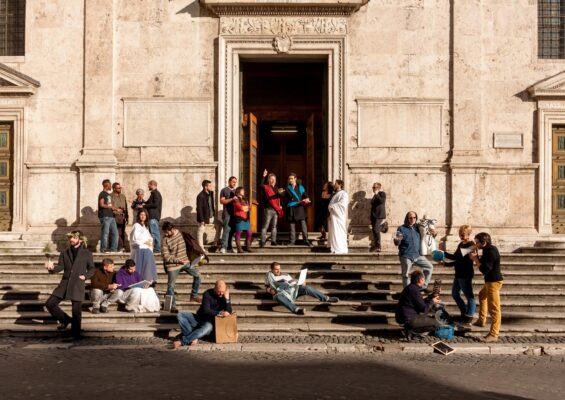
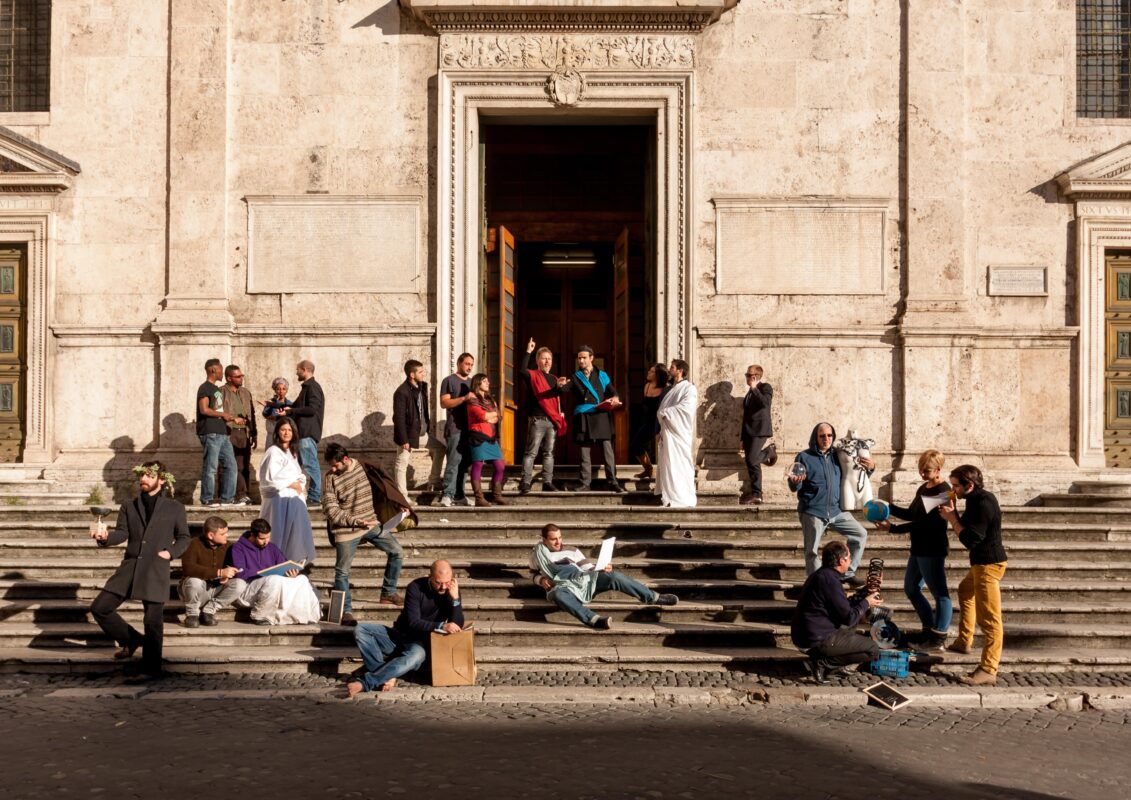
Rome, December 16, 2014 – On the steps of Santa Maria del Popolo, a spontaneous event revealed the beauty of the so-called “School of Rome.” The artist Gio Montez invited dozens of Roman artists to a unique gathering: to discuss “what is right and appropriate for an artist to do.”
From this meeting arose Manifesta Action No. 26 – Revelation, a flash mob in the style of a happening that, thanks to its spontaneity, became a completed work of art. As Montez told the astonished passersby:
“Artists gather to reveal through beauty what is right to do.”
(Gio Montez)
Proclaims the artist to the astonished passersby, suddenly projected into a collective action reminiscent of the Athenian agorà, the original space for dialogue and shared creation.
The birth of an artwork
The reference is intentional and explicit: the composition evokes Raphael’s School of Athens, yet subverts its perspective, order, and atmosphere.
The photograph documenting the action, titled The School of Rome, was taken by Francesco Perri and printed as a unique 160×90 cm piece, signed on the back by both Francesco Perri and Gio Montez, the latter also appearing within the scene itself. Numerous roman contemporary artists can be recognised on the steps. The costumes—deliberately eclectic and anachronistic—were assembled on the spot by Mimi Gazzarri and Claudia Paciucci.
Some meaningful absences
Some absences, however, became meaningful: the students from the nearest Academy of Fine Arts of Roma—the so-called “boni pittori” and “boni scultori”—did not attend, as Montez had revealed no details in advance, refusing any prior staging in favour of immediacy, a sort of superior trust in the extemporaneous Gestalt of all things that reveal to mankind . Also absent were the anachronists Roberto Ferri and Robertomaria Siena, who arrived late—ironically confirming, in both name and fact, their own anachronism.
Poetics of a rivelation
The choice of site is far from accidental. Santa Maria del Popolo—built in the 15th century “at the expense of the Roman people” and home to masterpieces by Raphael, Bernini, Caravaggio, Carracci, and Pinturicchio—is one of the most symbolically charged monuments of the Roman Renaissance. It is in dialogue with this heritage that Montez constructs the poetics of the action.
RIVELAZIONE n. [from Latin revelatio -onis, derived from revelare “to reveal”].
-
The action or act of revealing; the fact of revealing oneself or of being revealed. In particular:
a. In the history and tradition of various religions that recognize a divine origin, the fact and the act by which the divinity—directly or indirectly—reveals itself, its own existence and nature, or its will and certain truths that are either inaccessible to human knowledge or, though knowable, are included in the revelation to render them more certain.
b. In criminal law, the designation of various types of offenses whose common element is the unlawful disclosure of facts or information that should have remained secret.
c. In scientific and technical language, the fact, operation, or process by which quantities or entities are made observable. -
a. The thing itself, the information revealed: he listened in shock to that terrible revelation; the document contains revelations of utmost importance.
b. By hyperbole, used in reference to unexpected discoveries, to facts that suddenly come to light, to truths that, once known, provoke great surprise, or to manifestations of previously unsuspected qualities—whether good or bad—in a person.
THE NEW REINASSANCE INQUIRY
At the highest point of Renaissance inquiry—an era that sought to harmoniously fuse the ancient Greek and Roman cultural worlds—figures are no longer merely represented or displayed, but revealed. This idea lies at the very heart of Raphael’s poetics: the image is not simply an object to be observed, but an apparition, a gradual manifestation of the subject’s inner truth.
an act of knowledge
“Revelation” therefore, becomes an act of knowledge: it is not a matter of showing what the eye already sees, but of enabling the gaze to grasp what is deeper and truer. In this sense, art is no longer mere representation but a process of unveiling, an opening toward a higher reality.
Gio Montez captures this tension between Greek classicism, Roman monumentality, and Renaissance spiritual aspiration, reinterpreting it through a contemporary lens.
The retrospective significance of the artwork
Interestingly, Action No. 26 was not originally conceived as part of the Manifest Actions cycle. At the time, Montez was immersed in academic study and in developing a project for a poetic of a “New Renaissance” aimed at renewing the Italian artistic language.
Only eleven years later, upon reexamining what the happening had organically produced, formally acknowledged its significance and included it in the cycle. The revelation is therefore twofold: the work reveals itself, and the artist retroactively recognises the power of the collective revelation, being himself as an anachronistic spectator in front of his own work.
Contemporary Roman Artistic Heritage
The strength of Action No. 26 lies in its self-generative nature:
it is not an artwork performed, but an artwork that happened, constructed by the relationships among participants, by the site, the light, and the astonishment of passersby. It is a communal gesture that turns into an image, so to say the form of a testimony: the heritage.
the beauty of human encounter
The photograph The School of Rome captures this communal gesture, transforming it into a form of testimony and heritage. The artists involved created the project under the acronym P.A.R.Co. (Contemporary Roman Artistic Heritage).
With this work, Montez affirms a fundamental principle of the Manifeste Actions: art is the revelation of reality through a spontaneous and shared act, where beauty coincides with the truth of human encounter.
Production: Atelier Montez
Photography: Francesco Perri
Costumes: Michela Gazzarri e Claudia Paciucci
Video: Giacomo Capogrossi
Regia: Gio Montez
Actors: Gio Montez, Kristina Milakovic, Marco Fioramanti, Sergio Angeli, Giovanni Intrigila, Claudia Paciucci, Cristiano Quagliozzi, Milena Scardigno, Andrea Farallo, Francesco Astiaso Garcia, Corrado Delfini, Giacomo Capogrossi, Kaey Art, Emeka Meltrus, Youssuf, Amin Nour, Hektor, Laura Grispigni, Alessandro Calizza, Marco Ercoli, Diego Nocella, Diego Nipitella.