On 2 November 2016, in the spaces of Atelier Montez on Via di Pietralata, Gio Montez carried out Action n°13 – Situazione, an artistic intervention that marked a turning point in the dialogue between visual arts, theatre, and lived space. The action took place in conjunction with the theatrical production “021116 – Situation Act #1 – Inferno”, inspired by the thought of Jean-Paul Sartre and directed by Claudio Di Paola, within a project conceived as an organic fusion of theatrical staging and artistic production.
Theatre ad visual art meets...
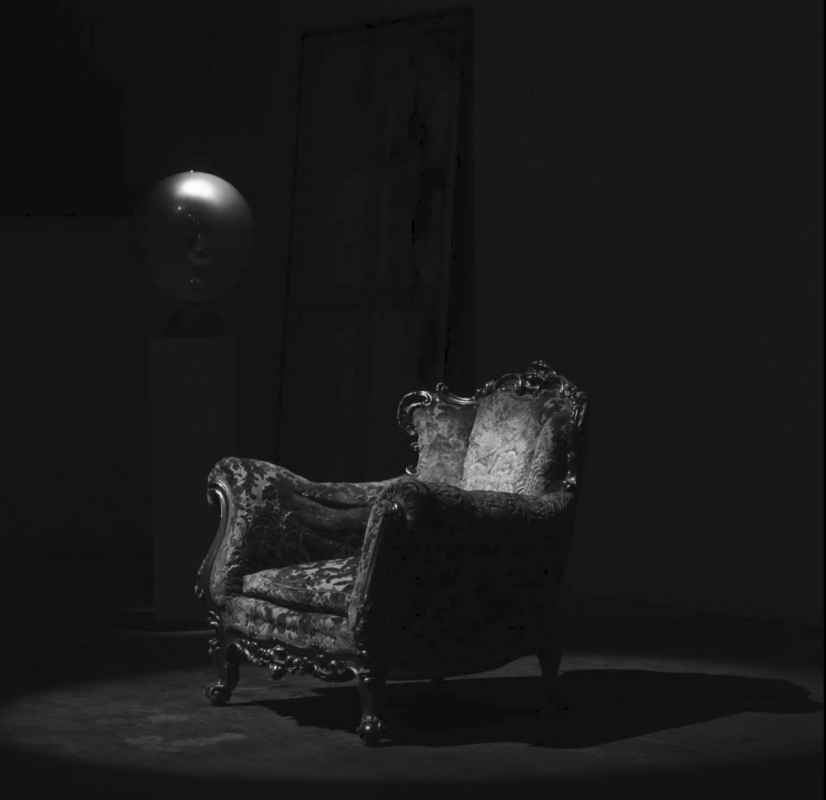
Action n°13 – Situazione emerges from the encounter between the dramaturgical dimension of Di Paola’s theatre and the plastic and conceptual research of Gio Montez. For the staging of the Sartrean piece, the artist conceived and produced a series of device-works, intended not as closed and autonomous objects, but as living, interactive, and inhabitable entities, capable of acquiring meaning, function, and orientation only through theatrical action and the presence of the audience. The works created by Montez operate as cognitive and scenic instruments. Among them is Bronzo di Barbedienne di Montez, a sculpture made of mylar and molten lead endowed with a reproducible life cycle: the work “deflates” over time, yet can be endlessly recharged to return to its original form, introducing themes of precarity and the reiteration of existence;This work is also a hyperbole on the technical reproducibility of the work of art characteristic of the bronze works of the famous French bronze artist. Seduta con Sgarbi is instead an armchair missing one leg, rebalanced by a volume on contemporary art written by Vittorio Sgarbi, which becomes an actual physical support for both actors and spectators, transforming the book into a structural and ironically indispensable element. Porta Chiusa marks the boundary between everyday space and theatrical space: crossing it means entering the dimension of representation; closing it again turns the stage into perceived reality. Alongside the door-object stands Porta Chiusa (screen print), the only purchasable element, which symbolically allows one to “exit” the theatre, overturning the very notion of access and participation. Also included among the scenic devices are three framed white canvases, conceived as three empty paintings, each explicitly associated with one of the actors of the Sartrean piece. These canvases represent at once a concrete spatial presence and a latent pictorial potential: they are not images, but surfaces of expectation. The “painting” takes form through the actions, gestures, and movements of the actors who perform in front of them, transforming the void into a field of projection in which meaning is continuously produced by presence rather than representation.
Hell is other people
In line with Sartre’s thought, Gio Montez gives visual form to the principle “hell is other people,” transforming seemingly idyllic art objects into instruments of existential torture. It is the presence of the other—audience, actor, spectator—that converts these devices into infernal elements, capable of generating tension, judgment, and conflict. Art does not console; it exposes. It stages the impossibility of escaping the gaze of others, which defines and possesses being without ever returning it in full transparency. The traditional separation between audience and stage is abolished. Spectators become active fragments of the Situation, inhabiting the space even before the actors and participating in the aesthetic and emotional construction of the event. The production thus adopts a participatory model: admission is free, but in order to leave, the audience must support the production of the work as a whole by purchasing the “exit ticket,” thereby assuming a direct role in the production.
Action n°13 – Situazione is situated within an experimental cognitive dimension, in which art transcends the limits of the object and moves into the perception of the other-than-self. Hell, in this experience, is not a metaphysical place, but a collective, earthly condition generated by relationships. A radical experiment that transforms the stage into reality and reality into stage, bringing art to coincide with the very experience of existence.
situation n. (from Old French situacion)
early 15c., situacioun, “place, position, or location,” from Old French situacion or directly from Medieval Latin situationem (nominative situatio) “a position, situation,” noun of action from past-participle stem of situare “to place, locate,” from Latin situs “a place, position” (from PIE root *tkei- “to settle, dwell, be home”). The meaning “state of affairs, position with reference to circumstances” is from 1710; the meaning “employment, post, office” is by 1803.