
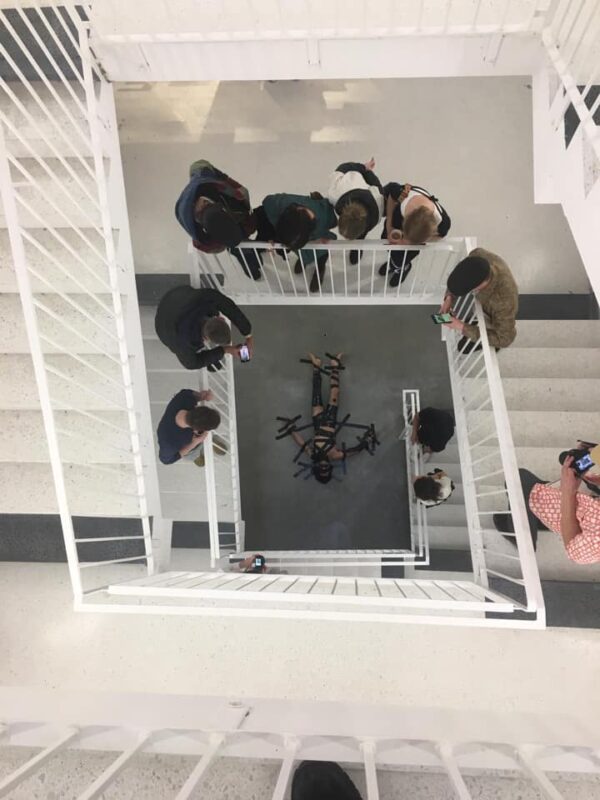
Action n°28 – Mercificazione by Gio Montez
Independent Art Fair, Stockholm
Stockholm – At the Independent Art Fair of Stockholm, Gio Montez presented Action n°28 – Mercificazione, a radical performance reflecting on the intersection between art, commerce, and human experience. Inspired by idyllic days spent in Stockholm with his German Familie Montez companions, Montez conceived a meditation on “the perfect day”, recalling the legendary 1999 performance by Maurizio Cattelan in which he famously taped his gallerist Massimo De Carlo to the wall.Drawing further inspiration from the “Gaffa Tape” aesthetic typical of his master Mireck Macke, Montez transformed himself into an exhibition object, turning his own body into a living artwork for the fair. The performance interrogates the question: how can one display an artistic phenomenon like “Montez” itself, assigning economic value to entities that normally resist commodification—human relationships, shared experiences, culture, and the passage of time?
To realize this reflection, Montez staged himself on the spiral staircase of the exhibition building, inverting spatial perception and gravitational orientation in a painterly game of scale and form. Immobilized, unable to speak or make eye contact, he restricted himself entirely to the role of “commodity-object”, forcing viewers to confront the tensions between lived experience and its conversion into a commercialized spectacle.
Action n°28 – Mercificazione transforms the artist’s body into both product and artwork, embodying the paradox of value in contemporary art and the absurdity of turning ephemeral moments into objects for trade. Through this extreme gesture, Montez questions the limits of exchange, visibility, and the performative potential of art itself, creating a vivid reflection on the commercialization of life and creativity.
Mercification n. [from mercificare “to commodify”]. – In contemporary philosophical and sociological literature, influenced by Marxian concepts of commodity fetishism and reification, the term refers to the transformation of things that by their nature would not normally be objects of commerce into commodities (human qualities, social relationships, cultural traditions, ideal or aesthetic values, etc.). This phenomenon is considered characteristic of capitalist societies, founded on the exchange of goods and consumption: the mercification of the human body (in advertising and pornography); the mercification of religious meaning; the mercification of natural beauty.